
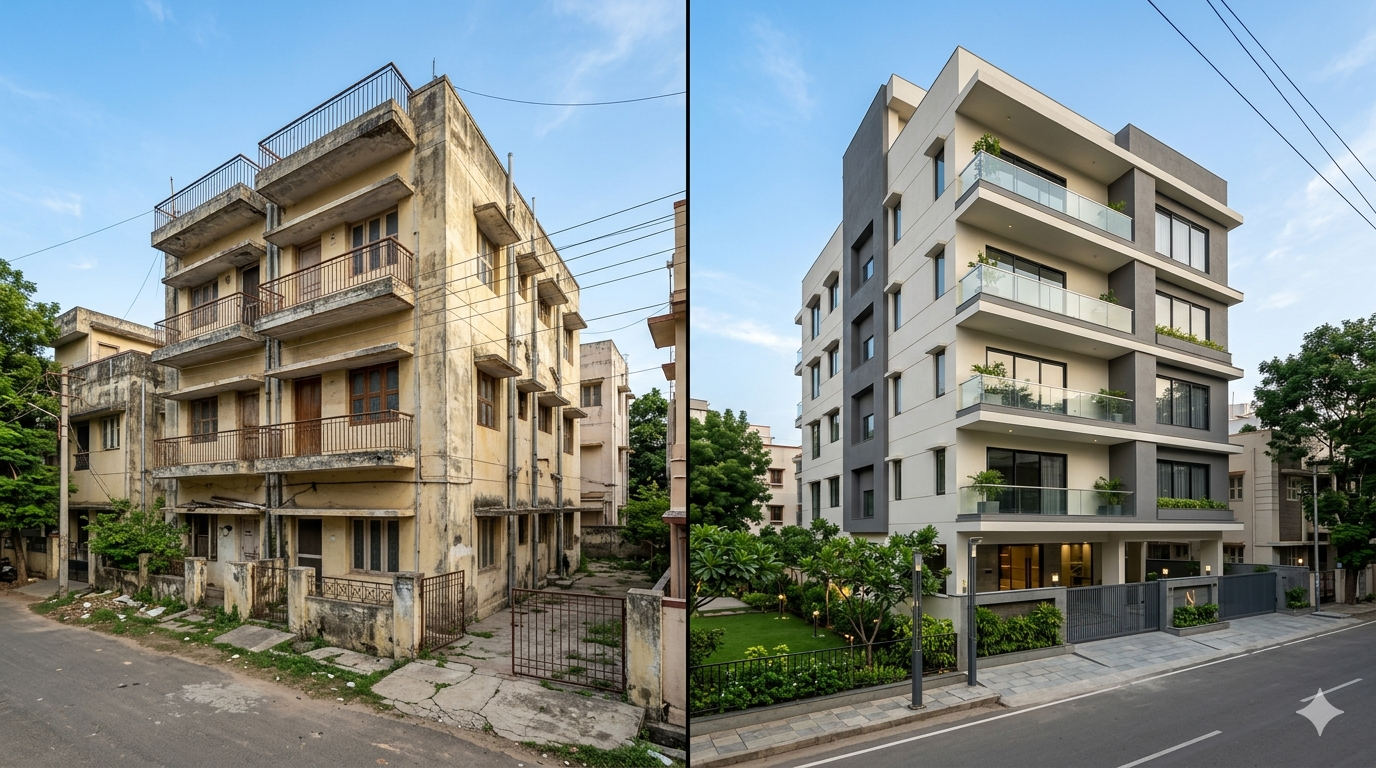
Walk through the older residential pockets of Chennai — Triplicane, Nungambakkam, Virugambakkam, or Valasaravakkam — and you will notice a pattern. Aging apartment buildings with water-stained facades, rusting grilles, crumbling plaster, and overloaded electrical systems. For many residents, these are familiar frustrations. But for those who understand construction and property value, these same buildings represent something else entirely. Old building redevelopment in Chennai has quietly become one of the most discussed subjects among housing societies, property owners, and construction professionals alike. If your building is 20 years old or more, this article will help you understand why that age matters — and what your options genuinely are.
Why Building Age Matters More Than You Think
A building does not simply grow old cosmetically. Age affects every layer of a structure — from the foundation to the roof slab. Reinforced cement concrete, the material used in most buildings constructed before the 2000s, has a functional lifespan that depends heavily on construction quality, maintenance history, and environmental exposure. In Chennai, that exposure is particularly demanding.
The city’s coastal humidity, intense monsoons, and high ambient temperatures accelerate the process of concrete carbonation and steel corrosion inside structural members. What begins as surface cracking or minor seepage can, over time, progress into compromised columns, weakened beams, and deteriorating slabs. Buildings constructed 20 to 40 years ago were often built under older codes with lower reinforcement standards and without the material technologies available today. This does not mean every old building is dangerous — but it does mean that every aging building deserves a serious, professional structural evaluation.
Renovation Versus Redevelopment: Understanding the Difference
Many housing societies default to patching problems as they arise — waterproofing treatments, tile replacements, minor civil repairs. This approach works when the structure itself is sound. But when structural assessments reveal that the core elements of a building are compromised, surface repairs become both expensive and insufficient.
Redevelopment — the partial or complete reconstruction of a building — becomes relevant when repair cycles are frequent and costly, when structural audits flag safety concerns, when the building no longer meets current regulatory or fire safety standards, or when the cost of sustained maintenance has exceeded the returns it delivers in livability or safety. In Chennai’s urban landscape, where land values have appreciated considerably, redevelopment also presents the possibility of building a safer, more modern structure on the same plot — often with improved space utilization, modern amenities, and compliance with current building codes.
It is important to note that redevelopment is not a quick or simple process. It requires structural assessments, legal documentation, regulatory approvals from bodies such as CMDA, society consensus, and careful planning for resident relocation during construction. None of these steps should be rushed or minimized.
Chennai-Specific Factors That Make This Conversation Urgent
Beyond climate and age, Chennai’s residential landscape adds further complexity. Many older apartment buildings sit in dense urban zones where neighboring structures are in close proximity, access roads are narrow, and construction logistics require careful management. Soil conditions across the city also vary — coastal zones carry different foundation considerations compared to inland or rocky terrain areas.
Additionally, the growing frequency of structural distress reports in older Chennai buildings has brought this issue to the attention of residents who may have otherwise deferred the conversation. A building that has survived multiple monsoon seasons without major maintenance may have accumulated hidden damage that only a qualified structural audit can reveal.
If your housing society has not conducted a formal structural inspection in the past five years, scheduling one is a prudent and responsible first step — regardless of whether redevelopment is ultimately the right path.
Sankar Infra Projects: Built for This Conversation
At Sankar Infra Projects, we work specifically with housing societies and apartment owners in Chennai who are navigating decisions about aging buildings. Our approach begins not with a sales pitch, but with a structured technical assessment of your building’s current condition.
We bring engineering expertise across the full spectrum of apartment reconstruction — from structural evaluation and planning, to phased demolition and rebuilding, to compliance with Chennai’s regulatory framework. Our team understands the unique demands of urban construction in this city: working within space constraints, managing resident communication, respecting timelines, and maintaining safety standards throughout every phase.
We are transparent about what redevelopment involves — including its complexities, timelines, and community coordination requirements. Our goal is to give your housing society the clarity it needs to make an informed decision, not to push a predetermined outcome.
Start With the Right Question
The conversation about old building redevelopment in Chennai should begin with a question, not an assumption. Is your building structurally safe? Is maintenance keeping pace with deterioration? Is your housing society equipped to manage the long-term costs of an aging structure?
These are decisions that deserve professional input, not guesswork. Sankar Infra Projects offers initial consultations to help housing societies understand where their building stands and what their realistic options are. Reach out to our team today and start the conversation with the clarity your community deserves.
