
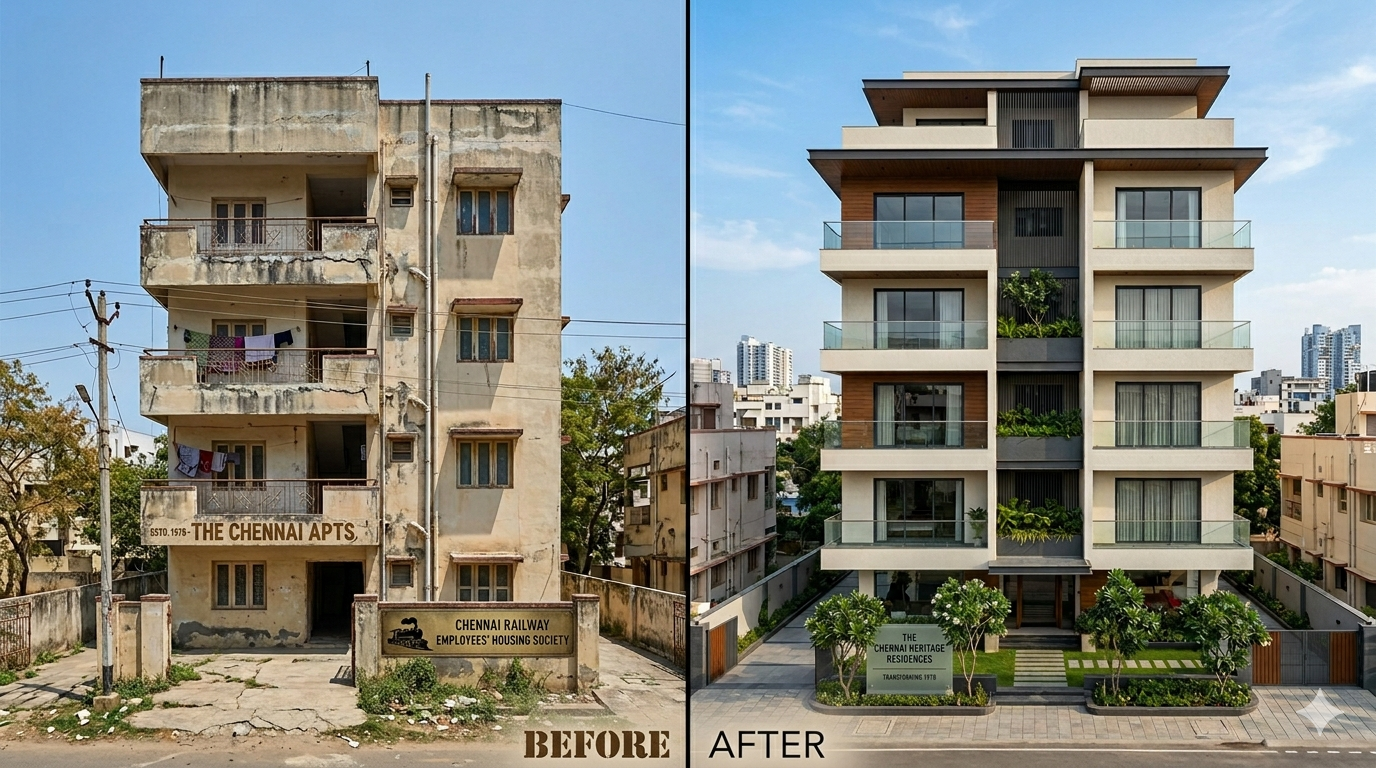
One of the most common oversights in apartment redevelopment discussions is the treatment of regulatory approvals as a formality — something to be handled later, after agreements are signed and plans are drawn. In reality, CMDA approval for redevelopment in Chennai is one of the earliest and most consequential steps in the entire process. The Chennai Metropolitan Development Authority governs what can be built, how tall, on what kind of land, and under what conditions. Housing societies that proceed without understanding this framework risk signing agreements that cannot be legally executed — or worse, commencing construction that faces regulatory stoppage midway. This article explains what CMDA approval involves, why it matters before any commitment is made, and what housing societies need to understand clearly before moving forward.
What Is CMDA and Why Does It Govern Redevelopment?
The Chennai Metropolitan Development Authority is the statutory planning body responsible for regulating land use, building construction, and urban development across the Chennai metropolitan area. Any new construction — including the demolition and reconstruction of an existing apartment building — requires formal approval from CMDA before work can legally begin.
CMDA operates within the framework of the Tamil Nadu Town and Country Planning Act and the Chennai Metropolitan Area Development Regulations. These regulations define the permissible Floor Space Index for a given plot, the maximum building height, mandatory setbacks from boundaries and roads, parking requirements, and permitted land use categories. All of these factors directly determine the feasibility and scope of any redevelopment project.
Floor Space Index: The Most Critical Number in Any Redevelopment Plan
FSI — the ratio of total built-up area to plot area — is perhaps the single most important regulatory factor in redevelopment planning. If a plot has an FSI of 2.0 and the plot area is 5,000 square feet, the maximum permissible built-up area is 10,000 square feet across all floors. This figure determines how many units can be constructed, which directly governs the economic viability of the project and any joint venture ratio being discussed.
FSI allowances in Chennai vary based on the plot’s location, road width, and zoning classification under the current development regulations. Plots fronting wider roads generally attract higher permissible FSI. Any builder or consultant who discusses unit allocation or project scope without first confirming the applicable FSI for your specific plot is working without a reliable foundation.
Key Approvals Required for Redevelopment in Chennai
CMDA approval for redevelopment in Chennai typically involves several distinct stages. First, the building plan must be prepared by a licensed architect or structural engineer in accordance with CMDA’s development regulations. This plan is then submitted to CMDA along with supporting documents including the title deed, patta, encumbrance certificate, structural drawings, and other required certificates.
Depending on the building’s height and area, additional clearances may be required — from the Tamil Nadu Fire and Rescue Services for fire safety compliance, from the Airport Authority if the site falls within aviation height restriction zones, and from local body authorities for drainage and water connection approvals. Each of these clearances adds to the overall approval timeline and must be accounted for in project planning.
How Long Does CMDA Approval Take?
This is one of the most frequently asked questions by housing societies considering redevelopment. The honest answer is that timelines vary considerably based on the completeness of the submitted documents, whether any queries or objections are raised during review, the complexity of the project, and whether additional clearances are required from other departments.
Housing societies should treat approval timelines as variable and plan project commitments accordingly. Any builder who guarantees a specific approval timeline without qualification should be questioned carefully — regulatory timelines are not within a builder’s control once documents are submitted.
Common Reasons CMDA Applications Face Delays or Rejections
In practice, many redevelopment applications encounter delays due to incomplete documentation, discrepancies between the title deed and actual plot measurements, proposed designs that exceed permissible FSI or violate setback requirements, unresolved encumbrances on the property, or missing clearance certificates from other departments. Addressing these issues before submission — rather than after — saves significant time and protects the housing society from frustrating and costly delays.
Sankar Infra Projects: Navigating Chennai’s Regulatory Framework With Precision
At Sankar Infra Projects, we treat regulatory compliance as the cornerstone of every redevelopment engagement. We do not begin planning conversations without first understanding the regulatory parameters that govern a specific plot — because a project designed outside those parameters has no reliable path to execution.
Our team works with experienced architects, structural engineers, and documentation specialists to ensure that every CMDA submission is prepared thoroughly and accurately. We guide housing societies through the documentation requirements, help identify and resolve title or encumbrance issues before they become obstacles, and maintain transparent communication about where approvals stand at every stage of the process.
We do not make promises about approval timelines, because regulatory decisions rest with CMDA. What we do commit to is a rigorous, well-prepared submission that minimizes the reasons for delay.
Get Regulatory Clarity Before You Commit
Signing a redevelopment agreement without understanding the applicable CMDA regulations for your plot is one of the most avoidable risks in this process. The right approach is to get regulatory clarity first — then structure your agreements around what is actually permissible and achievable.
Sankar Infra Projects offers detailed pre-project assessments for Chennai housing societies that include regulatory feasibility analysis. Reach out to our team before you sign anything, and ensure your redevelopment decision is built on accurate, verified ground
