
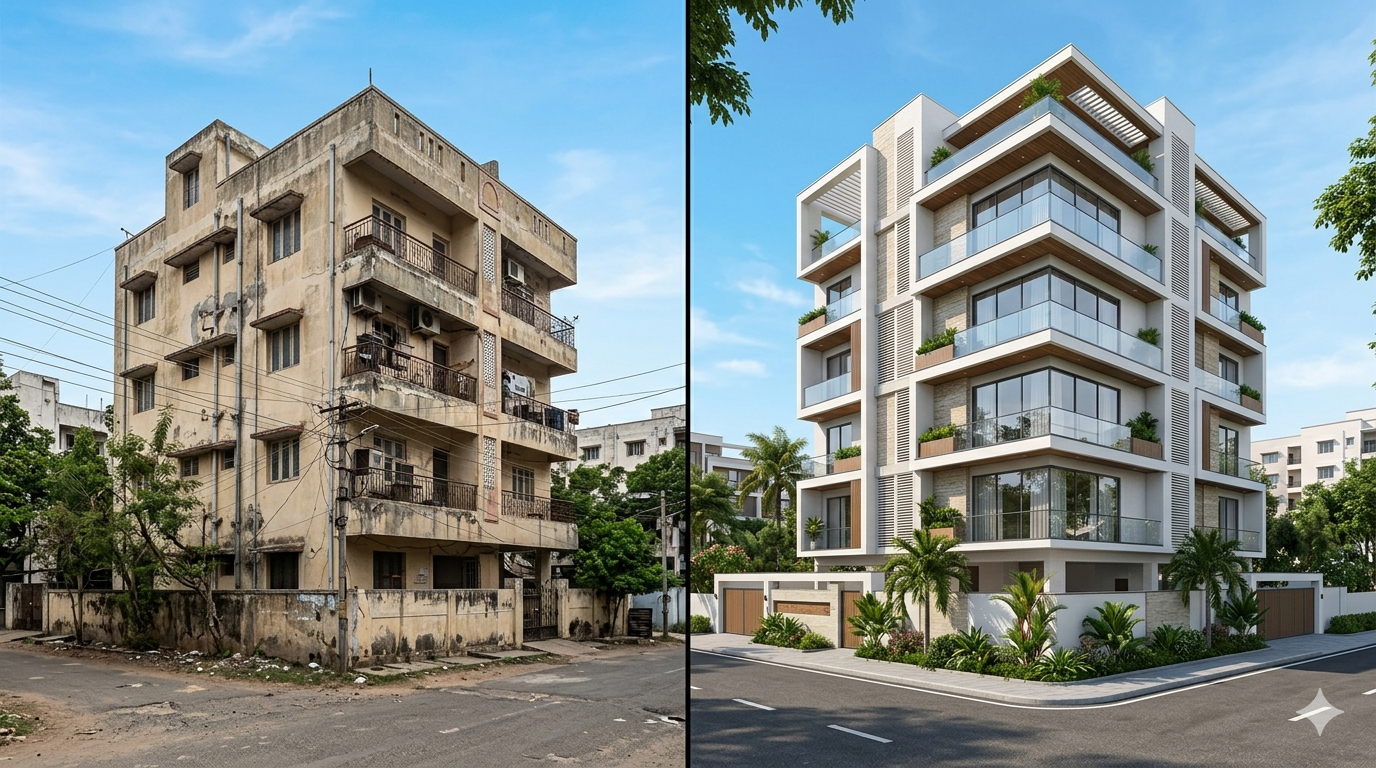
When a housing society in Chennai decides to pursue apartment redevelopment, the conversation quickly moves toward builders, costs, and construction timelines. What often receives far less attention — but deserves equal priority — is the legal framework that governs the rights of individual flat owners throughout the process. RERA apartment redevelopment in Chennai is an area where many property owners remain underinformed, leaving them vulnerable to agreements that do not adequately protect their interests. This article is not legal advice. It is a practical orientation to help flat owners and housing society members understand the broad legal protections available to them, the role of TNRERA in Tamil Nadu, and the questions every owner should be asking before any redevelopment agreement is signed.
What Is RERA and How Does It Apply to Redevelopment?
The Real Estate Regulation and Development Act, commonly known as RERA, was enacted to bring transparency, accountability, and structured consumer protection to India’s real estate sector. In Tamil Nadu, the Act is administered through TNRERA — the Tamil Nadu Real Estate Regulatory Authority. While RERA is most commonly associated with new residential project sales, its provisions carry relevance for redevelopment projects where new units are being created and sold, or where agreements between landowners and developers involve the transfer of constructed area.
For flat owners in a redevelopment project, RERA’s significance lies primarily in what it requires of developers and builders in terms of disclosure, documentation, and delivery accountability. Any redevelopment project that involves the creation and sale of new residential units above a specified threshold is generally required to be registered with TNRERA. This registration creates a formal record of the project, the developer’s commitments, and the agreed specifications — providing flat owners with a documented basis for accountability.
Key Protections That Flat Owners Should Understand
Flat owners entering redevelopment agreements benefit from several important protections that RERA and related legal frameworks provide. Understanding these at a general level equips housing society members to ask the right questions when reviewing any proposed agreement.
Disclosure of project details is a foundational requirement under RERA. A registered project must disclose the layout plan, construction specifications, timeline, and the developer’s credentials. This means that vague commitments about flat sizes, floor specifications, or amenities have no place in a properly structured redevelopment agreement. Everything must be documented and verifiable.
Flat owners have the right to receive the agreed constructed area. If the redevelopment agreement specifies that each original flat owner will receive a unit of a certain carpet area with particular specifications, those commitments are enforceable. Any deviation from agreed carpet area is a matter that TNRERA can adjudicate upon complaint.
Delivery timeline accountability is another area where RERA provides flat owners with recourse. While delays in construction are common and often involve factors outside a builder’s control, persistent or unjustified delays that cause financial or practical harm to flat owners — particularly those in temporary accommodation — can be addressed through the regulatory framework. This is why penalty clauses for delays must be clearly included in every redevelopment agreement.
Housing society members also retain the right to access project progress information throughout construction. A developer registered with TNRERA is required to update the project’s status periodically. This creates a layer of transparency that informal arrangements do not provide.
What Flat Owners Must Do Before Signing
Understanding your rights is valuable only if you exercise them before committing. Every flat owner in a housing society considering redevelopment should insist on independent legal review of the proposed agreement by a qualified property lawyer familiar with TNRERA provisions. No agreement should be signed under time pressure, and no verbal assurance — regardless of how credible the builder appears — should substitute for written, registered documentation.
Verify whether the redevelopment project is required to be registered with TNRERA based on its scale. Confirm that the agreement specifies carpet area, material specifications, timeline, penalty provisions, relocation support terms, and corpus fund arrangements in clear, unambiguous language. Understand the dispute resolution process available to you if commitments are not honored.
Chennai’s redevelopment landscape includes experienced, process-driven construction partners who welcome these questions — and those who do not. A builder’s response to requests for documented commitments and TNRERA registration is itself a signal about the kind of partner they will be throughout the project.
Sankar Infra Projects: Accountability Built Into Every Agreement
At Sankar Infra Projects, we approach every redevelopment engagement with the understanding that housing society members are not just construction clients — they are property owners with legal rights that deserve full respect. Our agreements are structured to be transparent, specific, and legally sound. We document every material commitment — flat specifications, timelines, relocation provisions, and quality standards — in written agreements that are reviewed and registered appropriately.
We support housing societies in understanding what they are entitled to expect from the redevelopment process and ensure that our engagement reflects those standards at every stage. Our goal is not just to complete a construction project. It is to be the kind of partner that housing societies can hold accountable — and who welcomes that accountability.
Know Your Rights Before the Process Begins
The protections available to flat owners during RERA apartment redevelopment in Chennai are meaningful — but only when flat owners understand and invoke them early. Waiting until problems arise to review your legal position is always more costly than understanding it before you sign.
Sankar Infra Projects offers consultations for Chennai housing societies that include clarity on documentation requirements and agreement standards. Reach out to our team today and ensure your community’s rights are protected from the very first step.
