was successfully added to your cart.
Category

Property Redevelopment

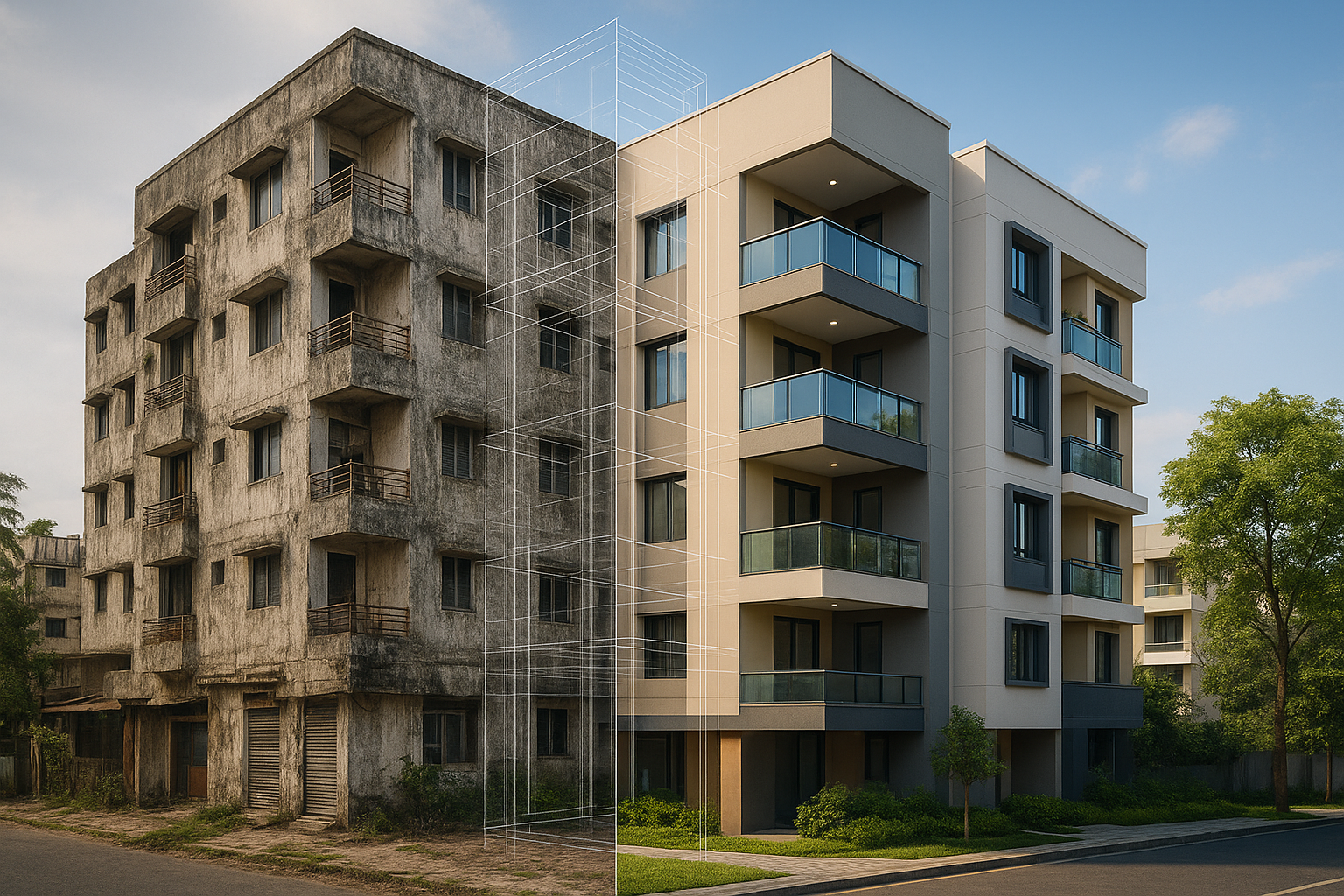
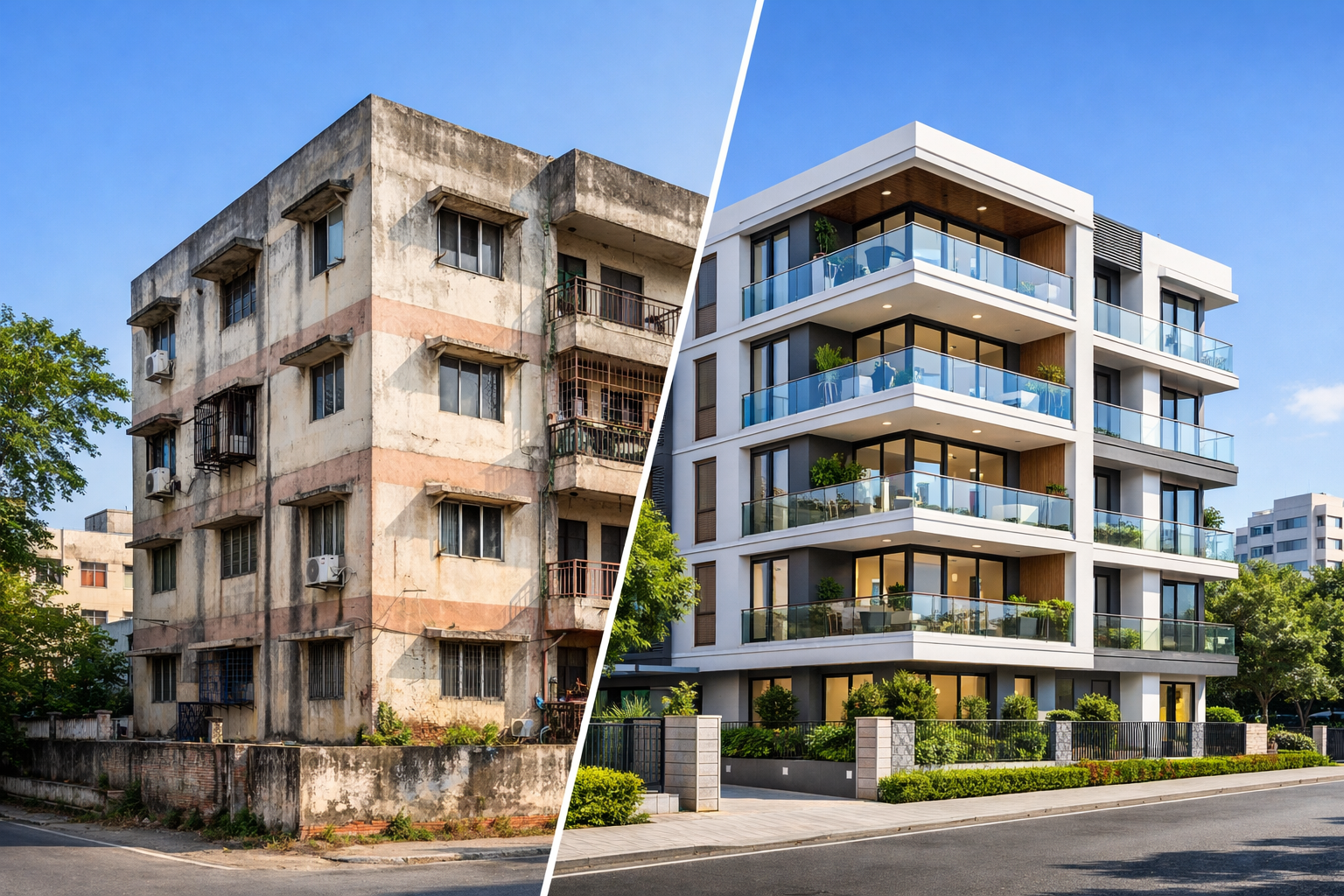
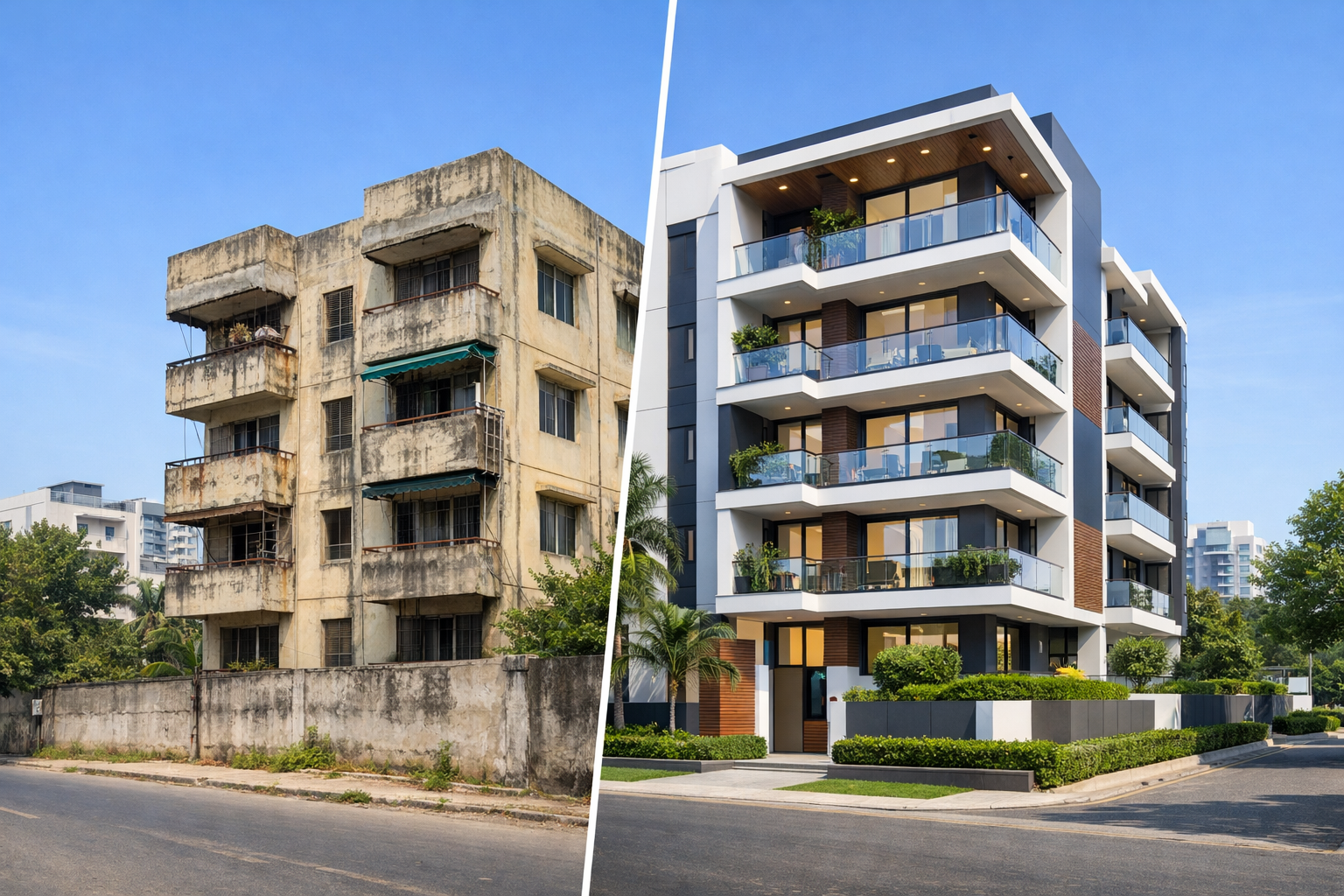
Apartment Redevelopment vs Renovation in Chennai: Which One Delivers More Value in 2026?

By | Property Redevelopment

For thousands of apartment owners across Chennai, 2026 is bringing a question to the forefront that can no longer be postponed. When a building starts showing its age through cracked walls, water seepage, corroded reinforcement bars, or failing plumbing, the choice between apartment redevelopment vs renovation in Chennai becomes one of the most consequential decisions a housing society will ever make. Getting this decision right requires more than a surface-level comparison. It requires an honest look at the building’s condition, the long-term needs of residents, and the financial and structural realities of each path.

What Renovation Involves and When It Makes Sense

Renovation, in the context of apartment buildings, refers to repair and improvement work carried out on an existing structure without demolishing it. This typically includes waterproofing treatments, replastering, plumbing upgrades, electrical rewiring, painting, and in some cases, strengthening of specific structural elements.

Renovation is a reasonable choice when the core structure of the building is still sound. If a structural audit confirms that the RCC framework, columns, beams, and slabs are in acceptable condition and the building is not beyond a certain age threshold, targeted renovation can extend the life of the property meaningfully.

However, renovation has clear limits. It addresses visible symptoms without necessarily resolving the underlying structural fatigue. In many cases, Chennai apartment buildings that underwent renovation five to ten years ago are now facing the same issues again, or worse. Patchwork repairs on a fundamentally weakened frame can create a false sense of security, which is why a credible structural assessment must always precede any decision.

What Redevelopment Involves and When It Is the Right Path

Redevelopment means demolishing the existing structure entirely and constructing a new building in its place on the same plot. This is a more comprehensive and permanent solution, and it is typically the right path when the building has crossed 25 to 30 years of age, when structural audits reveal deep-seated deterioration, or when the existing construction is using only a portion of the FSI currently permitted under CMDA norms.

In 2026, redevelopment has become increasingly attractive for Chennai housing societies because revised FSI norms often allow significantly more built-up area than what was originally constructed. This means that in many projects, existing flat owners receive brand new homes that are larger than their original units, typically without any out-of-pocket construction cost, depending on the commercial structure agreed with the developer.

Redevelopment also eliminates the recurring cost cycle of repeated repairs. Instead of spending on patchwork fixes every few years, the society receives a completely new structure built to current safety codes and engineering standards.

Chennai-Specific Factors That Make This Decision More Complex

Chennai’s climate adds a layer of urgency to this decision that is not always present in other cities. The city’s coastal humidity, intense monsoon seasons, and prolonged heat cycles accelerate the deterioration of RCC structures, especially in buildings constructed before the 1990s. Salt-laden air in coastal neighborhoods causes faster corrosion of steel reinforcement, which weakens structural integrity in ways that are not always visible to the untrained eye.

Urban density in areas like Adyar, Mylapore, Anna Nagar, and Velachery means that any construction work, whether renovation or redevelopment, must be carefully planned to minimize disruption to neighboring properties and public spaces. Community dynamics within a housing society also play a significant role. Renovation can often be carried out while residents remain in their flats, whereas redevelopment requires temporary relocation, which needs to be handled with clear communication and logistical support.

The financial comparison between the two options must also account for long-term value. Renovation costs money upfront and will likely need to be repeated. Redevelopment, when structured properly, can actually result in property value appreciation for existing owners, given the new construction quality, modern amenities, and increased floor area.

How Sankar Infra Projects Approaches This Decision

At Sankar Infra Projects, we understand that no two buildings or societies are alike. Our process begins with a detailed structural assessment of the existing building, followed by an honest evaluation of what renovation can realistically achieve versus what redevelopment can deliver over the long term.

We do not push societies toward redevelopment as a default. If renovation is the appropriate and sufficient solution for a given building, we say so clearly. Our engineering team is equipped to handle both paths with equal technical rigor, whether that means strengthening specific structural elements through targeted intervention or executing a full reconstruction project from demolition to handover.

For societies considering redevelopment, we walk the association through FSI entitlement, expected area gains, relocation planning, and the construction timeline in a transparent and structured manner. Our community-first approach ensures that residents are never left without information or support at any stage of the process.

Making the Right Decision for Your Society

The choice between renovation and redevelopment in Chennai is not one-size-fits-all. It depends on your building’s age, structural health, plot potential, and the long-term goals of your community. What matters most is that the decision is made on the basis of accurate information, not assumption or delay.

Sankar Infra Projects is available to support your housing society through a no-obligation structural and feasibility consultation. Reach out to us and take the first step toward a clear, informed, and confident decision for your community.

FSI and Floor Area Benefits in Chennai Redevelopment: How Societies Are Getting Bigger Flats for Free

By | Property Redevelopment

For apartment owners in Chennai, redevelopment is no longer just about fixing an aging building. It has become a genuine opportunity to gain more floor area without any additional land cost. Understanding FSI benefits in apartment redevelopment in Chennai is now one of the most important things a housing society can do before making any long-term property decision.

If your apartment complex was built 20 to 30 years ago, there is a strong chance that the original construction used only a fraction of the Floor Space Index permitted on your plot. Today, revised CMDA norms allow significantly higher FSI, and that unused potential can be converted into real, measurable space during redevelopment. This is the core reason why societies across Chennai are actively exploring reconstruction.

What Is FSI and Why Does It Matter in Redevelopment

FSI, or Floor Space Index, refers to the ratio of total built-up area to the total plot area. For example, if a plot is 5,000 square feet and the permitted FSI is 2.0, the developer can legally construct up to 10,000 square feet of built-up space on that plot.

Most older apartment buildings in Chennai were constructed under FSI norms that are now considered outdated. The CMDA has revised permissible FSI figures over time, especially in densely populated zones and along transit corridors. Under current 2026 CMDA guidelines, many plots in Chennai are eligible for FSI of 2.5 or higher depending on road width, zone classification, and building height permissions.

This gap between what was originally built and what is now permitted represents untapped floor area. During redevelopment, this additional permissible area can be used to give existing flat owners larger homes, with many projects also generating surplus units that are handed to the developer as part of the commercial arrangement.

How Apartment Owners Gain Bigger Flats

The benefit to existing apartment owners works through a straightforward logic. When a society approaches a redevelopment developer, the developer constructs the new building using the full permitted FSI. The existing flat owners receive newly built flats that are typically 20 to 40 percent larger than their original units, depending on the plot size, current FSI entitlement, and the number of existing units.

The extra floor area comes from utilizing the previously unused FSI, not from any out-of-pocket contribution by the residents. In many cases, the cost of temporary accommodation during construction and the stamp duty or registration charges for the new flat are also covered by the developer, though the specific terms vary from project to project and should always be reviewed with proper legal guidance.

Chennai-Specific Factors That Influence FSI Benefits

In Chennai, several local factors influence how much benefit a society can realistically expect from FSI-linked redevelopment.

Road width is a critical variable. Plots abutting roads of 12 metres or more are typically eligible for higher FSI under CMDA norms. Buildings on narrower roads may have limitations that reduce the overall development potential.

Zone classification also plays a major role. Residential zones, mixed-use zones, and special planning areas such as those near the MRTS or metro corridors may have different FSI ceilings and additional incentives.

The age and structural condition of the existing building matters too. Chennai’s coastal climate accelerates wear on RCC structures, particularly in areas closer to the sea. Salt-laden air, seasonal flooding, and extreme humidity contribute to faster deterioration of older buildings, making redevelopment a structural necessity in many cases, not just an opportunity.

The number of existing units in relation to total plot area determines whether the arithmetic of redevelopment is financially viable for both parties. A housing association must conduct a proper feasibility study before entering any agreement.

How Sankar Infra Projects Supports Societies Through This Process

At Sankar Infra Projects, we work with housing associations in Chennai to bring clarity to a process that many property owners find complex and unfamiliar. Our team begins with a thorough assessment of the existing plot, building condition, and current FSI entitlement under CMDA norms. This gives the society a clear picture of what redevelopment can realistically deliver before any commitment is made.

Our engineering approach prioritizes structural integrity in every phase of planning. We understand that redevelopment is not just a construction exercise. It involves real families, longstanding communities, and properties that carry decades of personal and financial value. Our communication process ensures that residents are informed at every stage, from design approvals to construction milestones.

We combine technical precision with a community-first mindset. Our project teams are experienced in managing urban construction within the constraints of Chennai’s dense residential neighborhoods, minimizing disruption while maintaining safety and quality standards throughout the construction cycle.

Making an Informed Decision About Redevelopment

FSI-linked redevelopment in Chennai represents one of the most tangible property benefits available to apartment owners today. Gaining a larger home without additional land investment is not a promise. It is a well-established outcome of policy-backed redevelopment when handled by experienced professionals.

If your housing society is evaluating whether redevelopment is the right path, the first step is understanding your plot’s actual FSI entitlement and the realistic floor area gain it can generate. Sankar Infra Projects is available to walk your association through this assessment with full transparency and no obligation. Reach out to us to begin the conversation.

How to Choose the Right Redevelopment Builder in Chennai: 8 Non-Negotiable Criteria

By | Property Redevelopment

The builder your housing society selects for apartment redevelopment will shape every aspect of the project — from the quality of the structure you return to, to the experience your community has during the months or years of construction. Yet many housing societies in Chennai approach this decision without a structured evaluation framework, relying instead on referrals, surface impressions, or the most persuasive proposal received. Understanding how to choose a redevelopment builder in Chennai requires going beyond presentations and price quotes. It requires examining a builder’s technical competence, process discipline, legal standing, and track record in ways that are verifiable — not just claimed. This article outlines eight criteria that every housing society should apply before committing to any redevelopment partner.

Eight Criteria That Define a Trustworthy Redevelopment Builder

  1. Verified Experience in Apartment Reconstruction

General construction experience is not the same as apartment redevelopment experience. Redevelopment involves demolition of occupied urban structures, coordination with multiple flat owners, regulatory compliance specific to reconstruction projects, and phased construction in dense environments. Ask any builder you evaluate to provide specific examples of completed apartment redevelopment or reconstruction projects in Chennai — not just new construction work. Visit completed projects where possible and speak with housing society representatives directly.

  1. In-House Structural Engineering Capability

Apartment redevelopment is fundamentally a structural engineering exercise before it is a construction one. A builder who relies entirely on outsourced structural consultants for assessments and design lacks the integrated capability that complex reconstruction demands. Look for builders with qualified structural engineers involved in their project planning process, not just their sales presentations. Chennai’s soil variability, coastal exposure, and aging building stock require engineering judgment that must be embedded in the execution team.

  1. Transparent and Detailed Agreement Documentation

How a builder approaches the agreement stage reveals their integrity more clearly than any marketing material. A trustworthy builder will produce a detailed, specific agreement that documents carpet area, material specifications, construction timeline, penalty provisions for delays, relocation support terms, corpus fund arrangements, and handover conditions. Vague agreements that rely on verbal clarifications are a serious warning sign. Every commitment your housing society is counting on must appear in writing, reviewed by an independent property lawyer before signing.

  1. Knowledge of Chennai’s Regulatory Framework

CMDA approvals, FSI calculations, local body clearances, fire safety compliance, and TNRERA registration requirements are all part of the regulatory landscape governing redevelopment in Chennai. A builder who cannot speak to these requirements with specificity — or who treats approvals as routine formalities — is either underqualified or oversimplifying a genuinely complex process. Ask directly how they manage the approval process, what documentation they prepare, and how they handle regulatory queries or rejections.

  1. Clear Relocation and Resident Management Plan

One of the most human dimensions of redevelopment is the displacement of families during construction. A builder’s approach to this aspect tells you a great deal about their values. Ask for a specific relocation plan — how corpus funds are calculated, when disbursements are made, how residents are kept informed during construction, and what provisions exist for vulnerable residents such as elderly owners or families with medical needs. Builders who treat this as a minor logistical detail are revealing how they will behave when the pressure of actual construction sets in.

  1. References from Previous Housing Society Clients

Ask every builder you evaluate to provide contact references from housing societies they have worked with — not developers or individual landowners, but multi-owner residential communities that experienced the full redevelopment process. Speaking with these references directly, asking about communication quality, timeline adherence, agreement compliance, and post-handover follow-through, will give you information that no proposal document can provide.

  1. Financial Stability and Project Funding Clarity

Redevelopment projects stall when builders face cash flow problems midway through construction. Before signing any agreement, understand how the builder is funding the project — particularly in joint venture arrangements where their revenue comes from unit sales after completion. Ask about their financial standing, whether they have completed projects of comparable scale without funding interruptions, and what contractual protections exist if the project encounters financial delays.

  1. Safety Standards and Site Management Practices

Construction safety in dense urban Chennai neighborhoods is a serious responsibility. Controlled demolition adjacent to neighboring structures, debris management on narrow roads, and worker safety protocols are all areas where builder competence directly affects the safety of your community and neighbors. Ask builders how they manage site safety, what certifications their teams hold, and how they have handled safety challenges in previous urban projects.

Sankar Infra Projects: Meeting Every Criterion With Consistency

At Sankar Infra Projects, we welcome evaluation against every criterion on this list. Our work in apartment reconstruction and building redevelopment across Chennai is built on structural engineering depth, transparent agreement documentation, and a genuine commitment to the communities we work with. We manage the full complexity of urban redevelopment — regulatory compliance, resident communication, phased construction, and quality delivery — with a process discipline that housing societies can verify before they commit.

We do not ask housing societies to trust us based on presentations alone. We invite scrutiny of our completed projects, our documentation standards, and our approach to the challenges that redevelopment consistently presents.

Evaluate Carefully. Decide Confidently.

Choosing the right redevelopment builder in Chennai is one of the most consequential decisions your housing society will make. The criteria in this article give you a structured basis for that evaluation — one that goes beyond surface impressions to the factors that actually determine project outcomes.

Contact Sankar Infra Projects today to begin a transparent conversation about your building’s redevelopment potential and to see firsthand how we measure against the standards your community deserves.

RERA and Apartment Redevelopment in Chennai: Your Legal Rights as a Flat Owner

By | Property Redevelopment

When a housing society in Chennai decides to pursue apartment redevelopment, the conversation quickly moves toward builders, costs, and construction timelines. What often receives far less attention — but deserves equal priority — is the legal framework that governs the rights of individual flat owners throughout the process. RERA apartment redevelopment in Chennai is an area where many property owners remain underinformed, leaving them vulnerable to agreements that do not adequately protect their interests. This article is not legal advice. It is a practical orientation to help flat owners and housing society members understand the broad legal protections available to them, the role of TNRERA in Tamil Nadu, and the questions every owner should be asking before any redevelopment agreement is signed.

What Is RERA and How Does It Apply to Redevelopment?

The Real Estate Regulation and Development Act, commonly known as RERA, was enacted to bring transparency, accountability, and structured consumer protection to India’s real estate sector. In Tamil Nadu, the Act is administered through TNRERA — the Tamil Nadu Real Estate Regulatory Authority. While RERA is most commonly associated with new residential project sales, its provisions carry relevance for redevelopment projects where new units are being created and sold, or where agreements between landowners and developers involve the transfer of constructed area.

For flat owners in a redevelopment project, RERA’s significance lies primarily in what it requires of developers and builders in terms of disclosure, documentation, and delivery accountability. Any redevelopment project that involves the creation and sale of new residential units above a specified threshold is generally required to be registered with TNRERA. This registration creates a formal record of the project, the developer’s commitments, and the agreed specifications — providing flat owners with a documented basis for accountability.

Key Protections That Flat Owners Should Understand

Flat owners entering redevelopment agreements benefit from several important protections that RERA and related legal frameworks provide. Understanding these at a general level equips housing society members to ask the right questions when reviewing any proposed agreement.

Disclosure of project details is a foundational requirement under RERA. A registered project must disclose the layout plan, construction specifications, timeline, and the developer’s credentials. This means that vague commitments about flat sizes, floor specifications, or amenities have no place in a properly structured redevelopment agreement. Everything must be documented and verifiable.

Flat owners have the right to receive the agreed constructed area. If the redevelopment agreement specifies that each original flat owner will receive a unit of a certain carpet area with particular specifications, those commitments are enforceable. Any deviation from agreed carpet area is a matter that TNRERA can adjudicate upon complaint.

Delivery timeline accountability is another area where RERA provides flat owners with recourse. While delays in construction are common and often involve factors outside a builder’s control, persistent or unjustified delays that cause financial or practical harm to flat owners — particularly those in temporary accommodation — can be addressed through the regulatory framework. This is why penalty clauses for delays must be clearly included in every redevelopment agreement.

Housing society members also retain the right to access project progress information throughout construction. A developer registered with TNRERA is required to update the project’s status periodically. This creates a layer of transparency that informal arrangements do not provide.

What Flat Owners Must Do Before Signing

Understanding your rights is valuable only if you exercise them before committing. Every flat owner in a housing society considering redevelopment should insist on independent legal review of the proposed agreement by a qualified property lawyer familiar with TNRERA provisions. No agreement should be signed under time pressure, and no verbal assurance — regardless of how credible the builder appears — should substitute for written, registered documentation.

Verify whether the redevelopment project is required to be registered with TNRERA based on its scale. Confirm that the agreement specifies carpet area, material specifications, timeline, penalty provisions, relocation support terms, and corpus fund arrangements in clear, unambiguous language. Understand the dispute resolution process available to you if commitments are not honored.

Chennai’s redevelopment landscape includes experienced, process-driven construction partners who welcome these questions — and those who do not. A builder’s response to requests for documented commitments and TNRERA registration is itself a signal about the kind of partner they will be throughout the project.

Sankar Infra Projects: Accountability Built Into Every Agreement

At Sankar Infra Projects, we approach every redevelopment engagement with the understanding that housing society members are not just construction clients — they are property owners with legal rights that deserve full respect. Our agreements are structured to be transparent, specific, and legally sound. We document every material commitment — flat specifications, timelines, relocation provisions, and quality standards — in written agreements that are reviewed and registered appropriately.

We support housing societies in understanding what they are entitled to expect from the redevelopment process and ensure that our engagement reflects those standards at every stage. Our goal is not just to complete a construction project. It is to be the kind of partner that housing societies can hold accountable — and who welcomes that accountability.

Know Your Rights Before the Process Begins

The protections available to flat owners during RERA apartment redevelopment in Chennai are meaningful — but only when flat owners understand and invoke them early. Waiting until problems arise to review your legal position is always more costly than understanding it before you sign.

Sankar Infra Projects offers consultations for Chennai housing societies that include clarity on documentation requirements and agreement standards. Reach out to our team today and ensure your community’s rights are protected from the very first step.

Adyar, Mylapore, and Anna Nagar: Why These Chennai Localities Are the Hottest Redevelopment Zones in 2026

By | Property Redevelopment

Not every locality in Chennai presents the same case for redevelopment. The decision to reconstruct an aging apartment building depends on multiple factors — the building’s structural condition, the plot’s regulatory potential, and the broader context of the neighborhood in which it sits. In established localities like Adyar, Mylapore, and Anna Nagar, these factors converge in ways that make apartment redevelopment a particularly relevant and timely conversation. For housing societies in these areas, understanding why apartment redevelopment in Adyar, Chennai and neighboring prime localities is attracting serious attention in 2026 can help communities make more informed decisions about their own aging buildings.

Why Established Localities Create Stronger Redevelopment Conditions

The logic behind redevelopment in prime Chennai localities rests on a straightforward principle. When a building sits on land in an area with strong residential demand, well-developed infrastructure, and proximity to employment, education, and commercial centers, the case for reconstruction becomes more compelling than it would be in a less connected location. The land itself carries greater inherent value, which influences everything from joint venture negotiations to the quality of new construction that becomes financially viable on the site.

Adyar, Mylapore, and Anna Nagar share several characteristics that position them as active redevelopment zones. Each locality has a significant inventory of residential buildings constructed between the 1960s and the 1990s. Many of these structures are now between 30 and 60 years old — an age range in which structural deterioration, outdated infrastructure, and code non-compliance are common. Chennai’s coastal proximity and high humidity levels have accelerated the deterioration of reinforced concrete in many of these buildings, particularly those within a few kilometers of the shoreline.

Adyar: Coastal Aging and Urban Density

Adyar’s proximity to the Adyar river and the Bay of Bengal makes it one of Chennai’s most environmentally exposed residential zones. Salt-laden air, high groundwater in parts of the locality, and intense monsoon exposure have taken a measurable toll on buildings constructed several decades ago. Many housing societies here report chronic waterproofing failures, corrosion in structural members, and increasing maintenance costs that patch problems without resolving them. The locality’s established infrastructure and continued residential demand make it a practical candidate for reconstruction where structural audits confirm the need.

Mylapore: Heritage Density and Structural Age

Mylapore is one of Chennai’s oldest and most densely populated residential localities. The concentration of aging buildings here is among the highest in the city. Many structures predate modern construction standards and were built without the structural engineering specifications that are required today. Urban density in Mylapore also creates execution challenges — narrow lanes, buildings in close proximity, and limited staging areas — that require experienced project management to navigate safely. For housing societies in Mylapore, the question is rarely whether their building needs attention. It is usually about understanding what form that attention should take and what the process involves.

Anna Nagar: Planned Layout, Aging Stock

Anna Nagar was developed as a planned residential township and carries a grid-based layout that gives it wider internal roads compared to organically developed neighborhoods. This infrastructure advantage makes construction logistics more manageable than in denser localities. However, the residential stock here is also aging. Buildings constructed in the 1970s and 1980s are now reaching the point where structural assessments are not optional — they are prudent. The locality’s planned character and continued appeal as a residential address make it well-suited for reconstruction projects where feasibility assessments confirm viability.

What Every Housing Society in These Localities Should Do First

Regardless of which of these localities your building is in, the starting point is always the same. A professional structural audit conducted by a qualified engineer provides the factual basis for every decision that follows. Without it, conversations about redevelopment are speculative. With it, housing societies can evaluate their options based on actual building condition, realistic regulatory parameters, and an honest understanding of what reconstruction would involve and cost.

Sankar Infra Projects: Experienced in Chennai’s Prime Locality Challenges

At Sankar Infra Projects, we have worked across Chennai’s established residential localities and understand the specific construction, regulatory, and community dynamics that characterize each area. Our approach to apartment redevelopment in Adyar, Mylapore, Anna Nagar, and comparable localities begins with a detailed technical and regulatory assessment that accounts for local soil conditions, coastal exposure, density constraints, and CMDA parameters applicable to your specific plot.

We do not offer generic project templates. Every engagement is structured around the actual conditions of your building and site. Our teams manage the full complexity of urban redevelopment — from structural engineering and controlled demolition through construction execution and regulatory compliance — with a consistent focus on safety, quality, and transparent communication with housing society members at every stage.

Find Out What Your Building’s Location Makes Possible

If your housing society is located in Adyar, Mylapore, Anna Nagar, or a comparable established locality in Chennai, understanding your building’s redevelopment potential starts with a professional assessment — not assumptions based on what neighboring societies have done.

Sankar Infra Projects offers structured consultations that give housing societies a clear, honest picture of their specific situation. Contact our team today and take the first informed step toward understanding what is genuinely possible for your community.

10 Mistakes Chennai Apartment Owners Make During Redevelopment (And How to Avoid Them)

By | Property Redevelopment

Redevelopment is one of the most consequential decisions a housing society can make. When it goes well, it delivers a safer, modern building and genuine value to every flat owner. When it goes wrong, the consequences — financial, legal, and personal — can be severe and long-lasting. Apartment redevelopment mistakes in Chennai are more common than most property owners realize, not because housing societies are careless, but because the process is genuinely complex and the information available is often incomplete or misleading. This article identifies the ten most frequent errors made by apartment owners and housing societies, so that your community can approach the process with greater clarity and confidence.

The Ten Mistakes That Derail Redevelopment Projects

  1. Skipping the Structural Audit

The most foundational mistake is proceeding with redevelopment planning without a professional structural assessment. A structural audit tells you the actual condition of your building — what is compromised, what can be retained, and what the reconstruction truly needs to address. Without it, every subsequent decision, including cost estimates and scope of work, rests on assumptions rather than evidence.

  1. Choosing a Builder Based on Price Alone

In a market where redevelopment involves significant financial stakes, the temptation to accept the lowest quote is understandable. But the lowest quote frequently reflects compromised material specifications, underestimated regulatory costs, or an inexperienced team. Evaluating a builder requires reviewing their past projects, verifying their technical credentials, and assessing whether their planning process is thorough — not just whether their number is attractive.

  1. Not Verifying Land Title Before Signing Agreements

Redevelopment agreements signed before title verification is complete create serious legal exposure. Unresolved encumbrances, disputed ownership shares, or discrepancies between registered documents and actual plot measurements can halt a project entirely after construction has begun. Title verification by an independent property lawyer is a prerequisite, not an afterthought.

  1. Ignoring FSI and Regulatory Feasibility

Discussions about how many floors will be built or how many new units will be created must be grounded in verified FSI entitlements under current CMDA regulations. Housing societies that negotiate unit allocation ratios before confirming the regulatory parameters of their plot often find that the agreed numbers are not achievable within the permissible construction envelope.

  1. Accepting Verbal Commitments

In redevelopment, every commitment must be documented. Verbal assurances about flat sizes, finish quality, relocation support, timelines, and corpus fund disbursements carry no legal weight. If a builder is unwilling to commit these details to a registered, legally reviewed agreement, that reluctance is itself a warning sign.

  1. Failing to Achieve Genuine Society Consensus

Redevelopment requires the agreement of a required majority of flat owners. Proceeding without genuine consensus — or with pressure tactics that override the concerns of dissenting members — creates internal conflict that can derail projects during construction, trigger legal challenges, and damage community relationships permanently. Consensus built through transparent information sharing is the only durable foundation.

  1. Underestimating Relocation Complexity

Temporary relocation during construction affects every family differently. Societies that treat relocation as a minor logistical matter often encounter significant distress — particularly among elderly residents, families with young children, or owners who have lived in the building for decades. A responsible redevelopment plan addresses relocation with specific provisions, clear timelines, and adequate financial support.

  1. Overlooking Chennai-Specific Construction Challenges

Chennai’s coastal humidity, variable monsoon intensity, and diverse soil conditions across different neighborhoods are not generic concerns — they are project-specific variables that affect foundation design, waterproofing specifications, and material selection. A redevelopment plan that does not account for these factors will produce a building that faces the same deterioration cycle within a shorter timeframe.

  1. Not Planning for Approval Timelines

CMDA approval timelines are variable and not within a builder’s control once documents are submitted. Housing societies that plan project milestones without building in regulatory buffer time find themselves in breach of relocation arrangements or facing financial pressure when approvals take longer than anticipated. Realistic planning requires treating approval timelines as ranges, not fixed dates.

  1. Treating the Project as Complete at Handover

The final mistake is disengaging once flats are handed over without verifying that all agreed specifications have been delivered, that completion certificates have been obtained, that common area work is finished, and that the builder has fulfilled every documented commitment. Post-handover follow-through is essential, and housing societies should have a clear checklist of deliverables to verify before formally closing out the builder’s obligations.

Sankar Infra Projects: A Process Built to Prevent These Mistakes

At Sankar Infra Projects, our engagement process is specifically structured to address each of these risk points. We begin every project with a structural audit and regulatory feasibility assessment. We document all commitments in transparent, legally reviewed agreements. We plan relocation support in detail, communicate consistently throughout construction, and do not consider a project complete until every documented obligation has been fulfilled.

Our experience in Chennai’s urban construction environment means we account for local climate, soil, and regulatory factors from the earliest planning stages. We work with housing societies as genuine partners, not just contractors, because we understand that the decisions made at the start of a project determine its outcome at every stage that follows.

Protect Your Community Before You Proceed

Every mistake on this list is avoidable with the right preparation and the right partner. The housing societies that navigate redevelopment successfully are those that ask the right questions early, verify before they commit, and choose partners who demonstrate process discipline rather than just project enthusiasm.

Sankar Infra Projects offers structured consultations for Chennai housing societies at any stage of the redevelopment conversation. Contact our team today to ensure your community’s redevelopment journey starts on solid ground.

From Crumbling to Contemporary: 7 Real Apartment Redevelopment Success Stories in Chennai

By | Property Redevelopment

For many housing societies in Chennai, the decision to pursue redevelopment feels abstract until they see what it looks like in practice. Reading about processes and regulations is useful, but nothing builds confidence quite like understanding how other communities in similar situations navigated the same journey. Apartment redevelopment success stories from Chennai offer exactly that — real context, grounded in the challenges that aging buildings present and the outcomes that structured, professionally managed reconstruction can deliver. The following accounts represent the kinds of transformations that have taken place across the city, drawn from the common patterns and experiences that define Chennai’s redevelopment landscape. Details have been generalized to reflect broader project types rather than specific identified properties.

Seven Transformation Patterns That Define Chennai’s Redevelopment Story

  1. The 40-Year-Old Coastal Building That Refused to Be Patched

A housing society in a southern coastal neighborhood had spent years managing recurring waterproofing failures, salt-induced concrete spalling, and corroded window frames. Each repair cycle became more expensive and shorter-lasting. A structural audit revealed that the reinforcement in several columns had corroded beyond repair. The society pursued full reconstruction, resulting in a new building with corrosion-resistant reinforcement, modern waterproofing systems, and upgraded flat sizes. The community relocated temporarily, returned to a structurally sound building, and eliminated the repair cycle that had consumed their maintenance corpus for over a decade.

  1. The Inner-City Building With a Narrow Access Problem

A six-unit building in a dense residential pocket near a major arterial road faced an access challenge — the lane leading to the plot was barely wide enough for a single vehicle. Many contractors had declined the project. A specialist team with urban construction experience designed a phased demolition and build sequence that used the lane strategically, staging materials at a nearby holding point and working in sections. The project was completed without damage to adjacent structures. The new building replaced a structurally compromised two-floor structure with a compliant four-floor building.

  1. The Housing Society That Almost Signed the Wrong JV Agreement

A twelve-unit society in a western suburb received three joint venture proposals with significantly different unit allocation ratios. Before signing, they engaged an independent technical consultant to assess FSI potential and construction costs. The analysis revealed that one proposal significantly undervalued the landowner’s share. Armed with this knowledge, the society renegotiated to a more equitable arrangement. The redeveloped building was delivered with modern specifications and each original owner received a larger, better-specified flat than what they had vacated.

  1. The Building Where Title Issues Nearly Derailed Everything

A society in central Chennai initiated redevelopment only to discover during the documentation phase that a portion of the plot had an unresolved encumbrance from a decades-old transaction. Rather than abandoning the project, the society worked with a property lawyer to resolve the encumbrance through the appropriate legal process before CMDA submission. The additional three months spent resolving the title issue saved the project from a far more damaging mid-construction legal dispute.

  1. The Vertical Expansion That Added Value Without Full Demolition

Not every aging building requires complete demolition. A structurally assessed building in a northern Chennai locality was found to have a sound lower structure but a failing top floor and inadequate infrastructure throughout. The project involved selective demolition of the upper two floors, structural strengthening of the retained portion, and reconstruction of improved upper floors. This approach reduced the overall project cost and shortened the relocation period for residents on lower floors.

  1. The Society That Prioritized Resident Communication Above All

A redevelopment project in a mid-city neighborhood involved thirty-two families — a scale that made resident management one of the most complex aspects of the project. The construction partner established a monthly communication protocol, shared construction progress reports, set up a dedicated point of contact for resident queries, and honored the agreed corpus fund disbursement schedule without exception. The project experienced no resident disputes during construction. Every family returned to the new building as planned.

  1. The Post-Monsoon Audit That Triggered the Right Decision

Following an exceptionally heavy monsoon season, a housing society commissioned a structural audit after noticing new crack patterns in their thirty-five-year-old building. The audit classified several structural elements as requiring immediate attention. Rather than attempting repairs on compromised structural members, the society chose full reconstruction. The new building, designed to current seismic and load standards, replaced a structure that had quietly accumulated significant hidden damage over decades.

Sankar Infra Projects: Turning These Lessons Into Your Project’s Foundation

Every apartment redevelopment success story in Chennai shares a common thread — informed decisions made at the right time, with the right professional support. At Sankar Infra Projects, our approach is shaped by precisely this understanding. We bring technical depth, transparent planning, and genuine respect for the communities we work with to every project we undertake.

From structural assessment through CMDA compliance, construction management, and resident coordination, we treat every project as a community responsibility — not just a construction contract. Our teams understand Chennai’s urban, climatic, and regulatory environment in practical, applied terms.

Your Building’s Story Hasn’t Been Written Yet

The housing societies featured in these patterns started where many others are today — uncertain, cautious, and unsure of their options. With the right guidance, each found a clear path forward.

If your housing society is evaluating redevelopment, Sankar Infra Projects is ready to help you understand your building’s specific situation. Contact our team for an initial assessment and start your community’s next chapter with clarity.


CMDA Approval for Apartment Redevelopment in Chennai: What You Must Know Before You Sign

By | Property Redevelopment

One of the most common oversights in apartment redevelopment discussions is the treatment of regulatory approvals as a formality — something to be handled later, after agreements are signed and plans are drawn. In reality, CMDA approval for redevelopment in Chennai is one of the earliest and most consequential steps in the entire process. The Chennai Metropolitan Development Authority governs what can be built, how tall, on what kind of land, and under what conditions. Housing societies that proceed without understanding this framework risk signing agreements that cannot be legally executed — or worse, commencing construction that faces regulatory stoppage midway. This article explains what CMDA approval involves, why it matters before any commitment is made, and what housing societies need to understand clearly before moving forward.

What Is CMDA and Why Does It Govern Redevelopment?

The Chennai Metropolitan Development Authority is the statutory planning body responsible for regulating land use, building construction, and urban development across the Chennai metropolitan area. Any new construction — including the demolition and reconstruction of an existing apartment building — requires formal approval from CMDA before work can legally begin.

CMDA operates within the framework of the Tamil Nadu Town and Country Planning Act and the Chennai Metropolitan Area Development Regulations. These regulations define the permissible Floor Space Index for a given plot, the maximum building height, mandatory setbacks from boundaries and roads, parking requirements, and permitted land use categories. All of these factors directly determine the feasibility and scope of any redevelopment project.

Floor Space Index: The Most Critical Number in Any Redevelopment Plan

FSI — the ratio of total built-up area to plot area — is perhaps the single most important regulatory factor in redevelopment planning. If a plot has an FSI of 2.0 and the plot area is 5,000 square feet, the maximum permissible built-up area is 10,000 square feet across all floors. This figure determines how many units can be constructed, which directly governs the economic viability of the project and any joint venture ratio being discussed.

FSI allowances in Chennai vary based on the plot’s location, road width, and zoning classification under the current development regulations. Plots fronting wider roads generally attract higher permissible FSI. Any builder or consultant who discusses unit allocation or project scope without first confirming the applicable FSI for your specific plot is working without a reliable foundation.

Key Approvals Required for Redevelopment in Chennai

CMDA approval for redevelopment in Chennai typically involves several distinct stages. First, the building plan must be prepared by a licensed architect or structural engineer in accordance with CMDA’s development regulations. This plan is then submitted to CMDA along with supporting documents including the title deed, patta, encumbrance certificate, structural drawings, and other required certificates.

Depending on the building’s height and area, additional clearances may be required — from the Tamil Nadu Fire and Rescue Services for fire safety compliance, from the Airport Authority if the site falls within aviation height restriction zones, and from local body authorities for drainage and water connection approvals. Each of these clearances adds to the overall approval timeline and must be accounted for in project planning.

How Long Does CMDA Approval Take?

This is one of the most frequently asked questions by housing societies considering redevelopment. The honest answer is that timelines vary considerably based on the completeness of the submitted documents, whether any queries or objections are raised during review, the complexity of the project, and whether additional clearances are required from other departments.

Housing societies should treat approval timelines as variable and plan project commitments accordingly. Any builder who guarantees a specific approval timeline without qualification should be questioned carefully — regulatory timelines are not within a builder’s control once documents are submitted.

Common Reasons CMDA Applications Face Delays or Rejections

In practice, many redevelopment applications encounter delays due to incomplete documentation, discrepancies between the title deed and actual plot measurements, proposed designs that exceed permissible FSI or violate setback requirements, unresolved encumbrances on the property, or missing clearance certificates from other departments. Addressing these issues before submission — rather than after — saves significant time and protects the housing society from frustrating and costly delays.

Sankar Infra Projects: Navigating Chennai’s Regulatory Framework With Precision

At Sankar Infra Projects, we treat regulatory compliance as the cornerstone of every redevelopment engagement. We do not begin planning conversations without first understanding the regulatory parameters that govern a specific plot — because a project designed outside those parameters has no reliable path to execution.

Our team works with experienced architects, structural engineers, and documentation specialists to ensure that every CMDA submission is prepared thoroughly and accurately. We guide housing societies through the documentation requirements, help identify and resolve title or encumbrance issues before they become obstacles, and maintain transparent communication about where approvals stand at every stage of the process.

We do not make promises about approval timelines, because regulatory decisions rest with CMDA. What we do commit to is a rigorous, well-prepared submission that minimizes the reasons for delay.

Get Regulatory Clarity Before You Commit

Signing a redevelopment agreement without understanding the applicable CMDA regulations for your plot is one of the most avoidable risks in this process. The right approach is to get regulatory clarity first — then structure your agreements around what is actually permissible and achievable.

Sankar Infra Projects offers detailed pre-project assessments for Chennai housing societies that include regulatory feasibility analysis. Reach out to our team before you sign anything, and ensure your redevelopment decision is built on accurate, verified ground

Joint Venture Redevelopment in Chennai: How Landowners Are Getting New Flats Without Spending a Rupee

By | Property Redevelopment

Across Chennai’s older residential neighborhoods, a growing number of apartment owners and housing societies are exploring a model that allows them to get a fully reconstructed building without funding the construction themselves. This model is called joint venture redevelopment, and it has become one of the most discussed options in Chennai’s real estate landscape. In a joint venture redevelopment Chennai arrangement, a landowner or housing society contributes the land and existing structure, while a builder or developer funds and executes the construction in exchange for a share of the newly built units. For property owners sitting on aging buildings with valuable land, this model deserves serious, informed consideration.

How Joint Venture Redevelopment Works

The core principle is straightforward. A housing society or landowner enters into a formal agreement with a construction or development company. The builder takes on the cost of demolition, construction, regulatory approvals, and temporary relocation support. In return, the builder retains a pre-agreed portion of the newly constructed flats or built-up area for sale. The landowners receive their share of the new building — typically upgraded flats with modern specifications — at no direct construction cost to themselves.

The ratio of units between landowner and builder is one of the most critical negotiating points in any JV agreement. This ratio varies based on several factors: the current FSI (Floor Space Index) permitted by CMDA regulations, the plot area, the projected number of units in the redeveloped building, the construction cost the builder will incur, and the market value of the location. In premium areas of Chennai such as Adyar, Nungambakkam, or Velachery, landowners may negotiate more favorable ratios given the higher saleable value of units in those locations. In less commercially active zones, the ratio will reflect the builder’s cost exposure more closely.

There is no universal JV ratio that applies to all projects. Any builder or consultant who offers a fixed ratio without first conducting a detailed feasibility assessment of your specific property should be approached with caution.

What a JV Redevelopment Agreement Should Cover

The legal framework of a joint venture redevelopment agreement is where most disputes originate. Housing societies entering this model must ensure that the agreement is comprehensive, legally reviewed by an independent property lawyer, and registered with the appropriate authorities. Key elements that must be clearly documented include the specific flats or built-up area allocated to the landowners, the construction timeline and penalty clauses for delays, the quality of materials and finishes to be used, temporary accommodation arrangements and corpus fund provisions during construction, and terms governing regulatory approvals and associated costs.

It is important to understand that a JV agreement is a legal and financial commitment of significant scale. The consent of a required majority of flat owners within the housing society is essential before any agreement can be signed, and this process must follow the rules of the society’s registered bye-laws.

Chennai-Specific Considerations for JV Redevelopment

Chennai’s regulatory environment adds important dimensions to JV redevelopment planning. CMDA guidelines govern FSI, setback requirements, building height permissions, and permissible land use. The feasibility of any JV project is directly shaped by these regulations, and understanding what is permissible on a given plot before entering negotiations is essential.

The city’s coastal humidity and variable soil conditions also affect construction specifications and, by extension, construction costs — which influence the JV ratio a builder can offer. In areas with complex soil profiles or high-water tables, foundation work is more demanding and expensive. These are factors that a credible builder will account for transparently in their project feasibility analysis.

Additionally, older apartments in Chennai often have unresolved legal issues — unclear title documents, pending property tax dues, or encumbrances — that must be resolved before any JV agreement can be executed. Attempting to proceed without clear title is one of the most common reasons redevelopment projects stall or fail.

Sankar Infra Projects: A JV Redevelopment Partner Built on Transparency

At Sankar Infra Projects, we approach joint venture redevelopment in Chennai as a partnership built on clear communication, technical integrity, and mutual respect for the landowner’s interests. We understand that housing societies are not just handing over a piece of land — they are entrusting us with their homes, their community, and their financial future.

Our process begins with a thorough feasibility assessment of your property — covering plot dimensions, FSI potential, structural condition, regulatory approvals required, and a realistic construction cost projection. We present this assessment honestly, including the constraints and variables involved, so that your housing society can make a fully informed decision.

We document every aspect of the JV arrangement in a transparent, legally structured agreement and support housing societies throughout the approval and construction process. Our commitment does not end at the agreement stage — it continues through delivery of the completed building.

Understand Before You Commit

Joint venture redevelopment is a genuine opportunity for many Chennai housing societies — but only when entered with full clarity about the terms, the partner, and the process. The risks of an uninformed decision in this space are significant.

If your housing society is evaluating a JV redevelopment proposal, begin with independent legal and technical advice. Then connect with Sankar Infra Projects for a transparent feasibility discussion. We are here to help you make the right decision for your community — not just the fastest one.

How Much Does Apartment Redevelopment Cost in Chennai? Full Breakdown for 2026

By | Property Redevelopment

One of the first questions housing society members ask when redevelopment comes up is a straightforward one: how much will this cost? Understanding apartment redevelopment cost in Chennai is not simple, because no two projects are identical. The size of the building, its current structural condition, the scope of reconstruction, location within the city, material specifications, and regulatory requirements all influence the final figure. This article does not provide fixed price guarantees — no responsible contractor can — but it does break down the key cost components that every housing society and apartment owner in Chennai should understand before entering into any redevelopment discussion.

What Drives the Cost of Apartment Redevelopment?

Redevelopment cost is not a single line item. It is the sum of multiple interconnected components, each of which varies based on project-specific factors. Here is a structured look at the major cost heads involved.

Structural Assessment and Pre-Construction Work

Before any construction begins, a qualified structural engineer must assess the existing building. This involves material testing, foundation evaluation, and load analysis. The cost of this phase depends on the building’s size and complexity, but it is a non-negotiable investment. Skipping or underinvesting in this step creates risk at every stage that follows. Pre-construction work also includes soil testing, topographic surveys, and architectural drafting — all of which contribute to the project’s baseline cost.

Demolition

For full reconstruction projects, controlled demolition of the existing structure is required. In Chennai’s dense urban neighborhoods — where buildings often share walls or sit close to adjacent structures — demolition must be carried out with precision to avoid damage to neighboring properties. This requires specialized equipment, experienced labor, and careful debris management. Demolition costs vary based on the building’s size, construction type, and site accessibility.

Civil Construction and Structural Work

This is the largest single cost component in any redevelopment project. It covers foundation work, column and beam construction, slab casting, brickwork, plastering, waterproofing, and all related structural elements. In Chennai, construction costs per square foot for residential reconstruction typically range based on the grade of materials used, the number of floors being built, and the structural design specifications. Higher floors, larger spans, and premium materials will naturally increase this figure. As a general orientation, mid-grade residential reconstruction in urban Chennai tends to fall in a broad range that housing societies should discuss directly with their contractor based on specific project parameters.

Regulatory Approvals and Compliance

Redevelopment projects in Chennai require approvals from the Chennai Metropolitan Development Authority, local body clearances, and compliance with fire safety and building bye-law requirements. The cost of obtaining these approvals — including professional fees for liaising with regulatory bodies — forms a meaningful part of the overall budget. Attempting to shortcut this process is not just legally risky; it can also result in construction halts, penalties, or demolition orders that cost far more than the approvals themselves.

Resident Relocation and Temporary Accommodation

In most full redevelopment projects, existing residents must vacate the premises during construction. The cost of temporary accommodation — whether through rental assistance provided by the developer or self-arranged — is a significant financial consideration for housing societies. This cost is often negotiated as part of the overall redevelopment agreement and should be clearly defined before work begins.

Interior Finishing and Common Area Development

Once the structural shell is complete, interior finishing — flooring, electrical, plumbing, fixtures, painting, and common area development — adds another substantial layer to the total project cost. The specification level chosen by the housing society directly determines expenditure in this phase.

Chennai-Specific Cost Factors

Chennai’s coastal climate introduces additional cost considerations. Structures near the coast or in areas with high groundwater require enhanced waterproofing systems and corrosion-resistant reinforcement to ensure long-term durability. Urban density in areas like Anna Nagar, Adyar, or T. Nagar also increases logistical costs — crane access, debris removal routes, and construction staging areas all become more expensive in tight urban sites.

Sankar Infra Projects: Transparent Cost Planning for Chennai Housing Societies

At Sankar Infra Projects, we understand that cost clarity is the foundation of trust in any redevelopment engagement. Housing societies deserve an honest, itemized understanding of where their investment goes — not vague estimates or figures that shift dramatically after work begins.

Our process starts with a detailed technical and financial assessment that accounts for your specific building, site conditions, scope of work, and material requirements. We do not offer one-size-fits-all pricing because Chennai’s redevelopment landscape does not work that way. What we do offer is a structured, transparent cost breakdown developed after a thorough evaluation of your project.

Our teams are experienced in managing the full cost spectrum of apartment reconstruction — from structural engineering and demolition through to finishing and regulatory compliance. We communicate clearly at every stage so that housing societies can plan with confidence and avoid unexpected cost escalations.

Get a Clear Picture Before You Decide

Apartment redevelopment is a major financial commitment, and it deserves careful, informed planning. The best way to understand what your specific project will cost is to start with a professional assessment — not an online estimate or a rough per-square-foot figure heard from a neighbor.

Sankar Infra Projects offers structured consultations for housing societies in Chennai who want a realistic, honest picture of their redevelopment costs. Contact our team today to begin that conversation with clarity and confidence.

})
Privacy Policy