
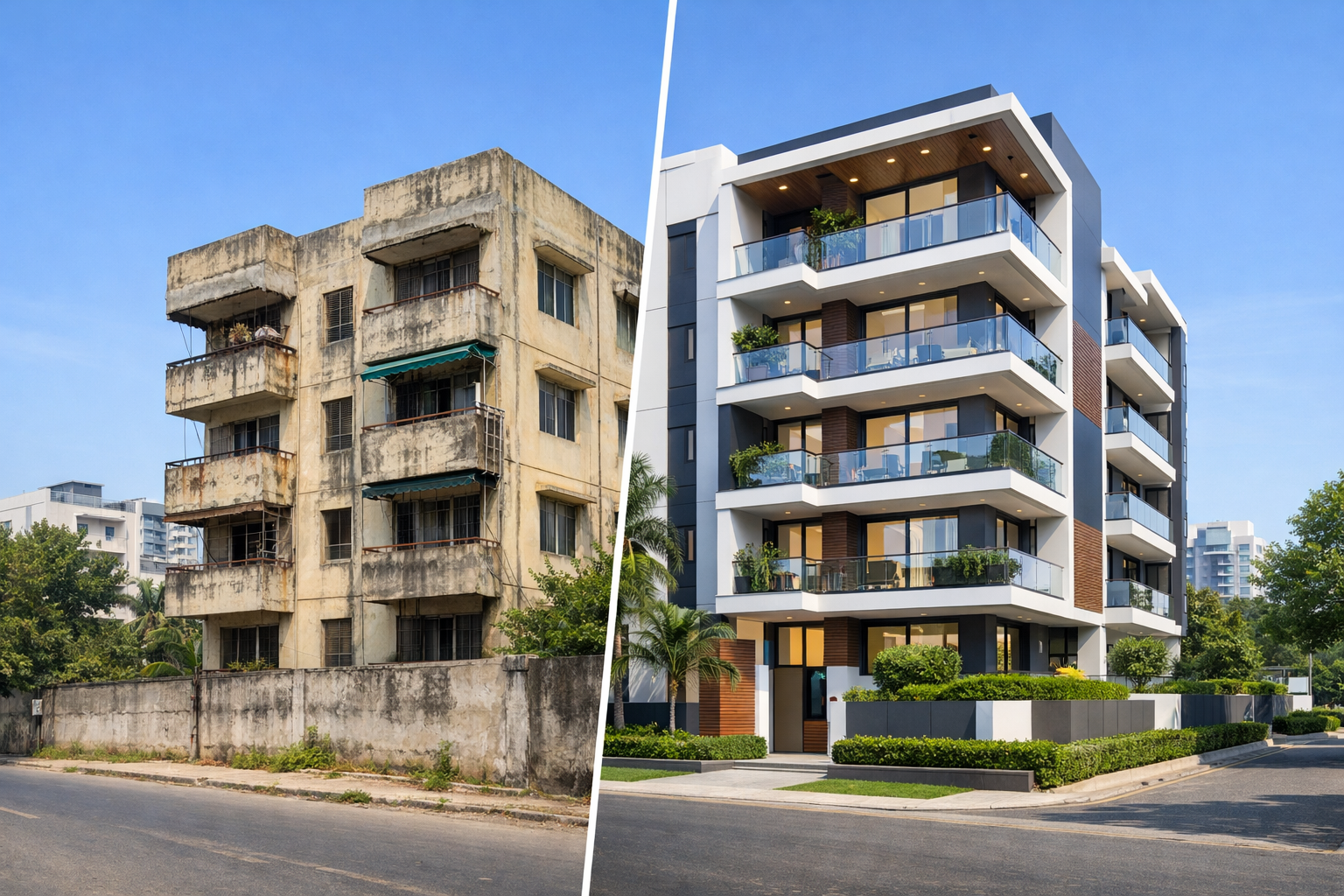
Most Chennai apartment owners approaching redevelopment are focused on one thing — getting more space, a structurally sound building, and a smoother life than before. What many do not realise is that the quality of that new building is increasingly defined not just by its size or layout, but by how it is built. Green building standards are now shaping apartment redevelopment in Chennai in ways that directly affect your flat’s comfort, long-term value, and operating costs. If your redevelopment project is being planned for 2026 and beyond, understanding what IGBC certification means — and whether it applies to your project — is worth your time before you sign anything.
Quick Answer
Green building redevelopment in Chennai refers to reconstruction projects that meet energy, water, and material efficiency standards set by the Indian Green Building Council (IGBC). For flat owners, an IGBC certified apartment means lower utility bills, better ventilation, reduced maintenance costs, and a higher resale value compared to conventionally built apartments.
What Is IGBC Certification and Why Does It Matter in Chennai
The Indian Green Building Council, a body under the Confederation of Indian Industry, certifies buildings across four rating levels: Certified, Silver, Gold, and Platinum. These ratings assess a building on parameters including site sustainability, water efficiency, energy performance, indoor air quality, and use of environment-friendly materials.
For Chennai specifically, green building design is not just a premium feature — it addresses real local conditions. The city’s coastal humidity accelerates material wear. Summers push cooling loads higher than most Indian cities. Many older apartment clusters in areas like Adyar, Velachery, Tambaram, and T. Nagar were built before energy efficiency was a consideration. Redevelopment gives owners a rare chance to correct that.
An IGBC certified apartment in Chennai typically includes rainwater harvesting systems, solar-ready infrastructure, low-VOC paints, efficient glazing to reduce heat gain, and waste segregation provisions. These are not luxury add-ons. They are design decisions that reduce your electricity bill, improve indoor air quality, and lower the building’s long-term maintenance burden.
[Internal Link: Sustainable Apartment Redevelopment Services Chennai]How Green Standards Apply During the Redevelopment Process
Green building compliance in redevelopment begins at the design stage, not after construction. The architect and structural engineer need to plan for green features before CMDA approval drawings are submitted. IGBC registration for a project happens early, and documentation is maintained throughout the construction phase before final certification is issued.
For apartment redevelopment projects in Chennai, the typical process looks like this:
Step 1: Structural audit of the existing building to confirm demolition is the right path and assess site conditions.
Step 2: Appointment of an IGBC-registered architect or consultant alongside the structural team.
Step 3: Incorporation of green features into the design — orientation, insulation, water systems, and materials — before CMDA plan approval.
Step 4: IGBC project registration and documentation tracking through the construction phase.
Step 5: Final inspection and rating award once construction meets required benchmarks.
It is worth noting that not every redevelopment project needs to pursue IGBC certification formally. However, incorporating green building principles — even without formal certification — adds measurable value to the finished flat.
[Internal Link: Structural Audit Services Chennai]What Flat Owners Should Ask Their Developer
Before entering a redevelopment agreement, flat owners should ask whether green building features are part of the design scope, whether the developer has experience working with IGBC-aligned architects, and what provisions are being made for energy and water efficiency in the new building. These questions help you understand whether the developer is thinking beyond square footage.
Older buildings in Chennai, particularly those built in the 1970s to 1990s, often have asbestos roofing, no waterproofing provisions, and inadequate ventilation. Redevelopment is an opportunity to address all of this systematically rather than patch by patch.
How Sankar Infra Projects Approaches Green Redevelopment
At Sankar Infra Projects, green building principles are part of our standard project planning, not an optional upgrade. Every redevelopment project we undertake begins with a thorough structural audit, followed by design coordination that accounts for Chennai’s coastal climate, density challenges, and resident safety requirements.
Our team works with architects familiar with IGBC documentation requirements and CMDA submission standards. We maintain transparency with resident associations at every stage — from initial feasibility assessment through design approval, construction, and handover. Resident inconvenience during construction is real, and we plan site logistics with that in mind.
For flat owners considering sustainable redevelopment in Chennai, our approach ensures that the new building is not just structurally sound but built to perform well over decades — not just at handover.
[Internal Link: Apartment Redevelopment Consultation Chennai]Frequently Asked Questions
Is IGBC certification mandatory for apartment redevelopment in Chennai? IGBC certification is not currently mandatory for all residential redevelopment projects in Chennai. However, projects above certain built-up area thresholds may require green building compliance under Tamil Nadu development norms. Your architect and developer should clarify this based on your specific project size.
Does an IGBC certified apartment cost more to build? Green building features typically add 3 to 8 percent to construction costs depending on the rating level targeted. However, operational savings on electricity and water over the building’s lifespan generally offset this within 5 to 7 years.
How does Chennai’s climate affect green building design choices? Chennai’s heat and humidity require specific design responses — shading devices, cross-ventilation planning, high-performance glass, and materials that do not absorb excessive heat. A green building approach accounts for these factors at the design stage rather than relying on air conditioning to compensate later.
What happens if green features are not included during redevelopment? Flat owners end up with a new building that performs no better than the old one in terms of energy and water consumption. Resale value may also be lower compared to IGBC certified or green-compliant buildings as buyer awareness increases.
Conclusion
Green building redevelopment in Chennai is no longer a niche concern. It is a practical decision that affects your flat’s comfort, running costs, and long-term value. Understanding IGBC certification and what it requires helps you ask better questions of any developer before committing to a redevelopment agreement. If you own a flat in an aging Chennai apartment block and want to understand whether green redevelopment is the right path, Sankar Infra Projects offers a no-obligation consultation to walk you through your options honestly.
