
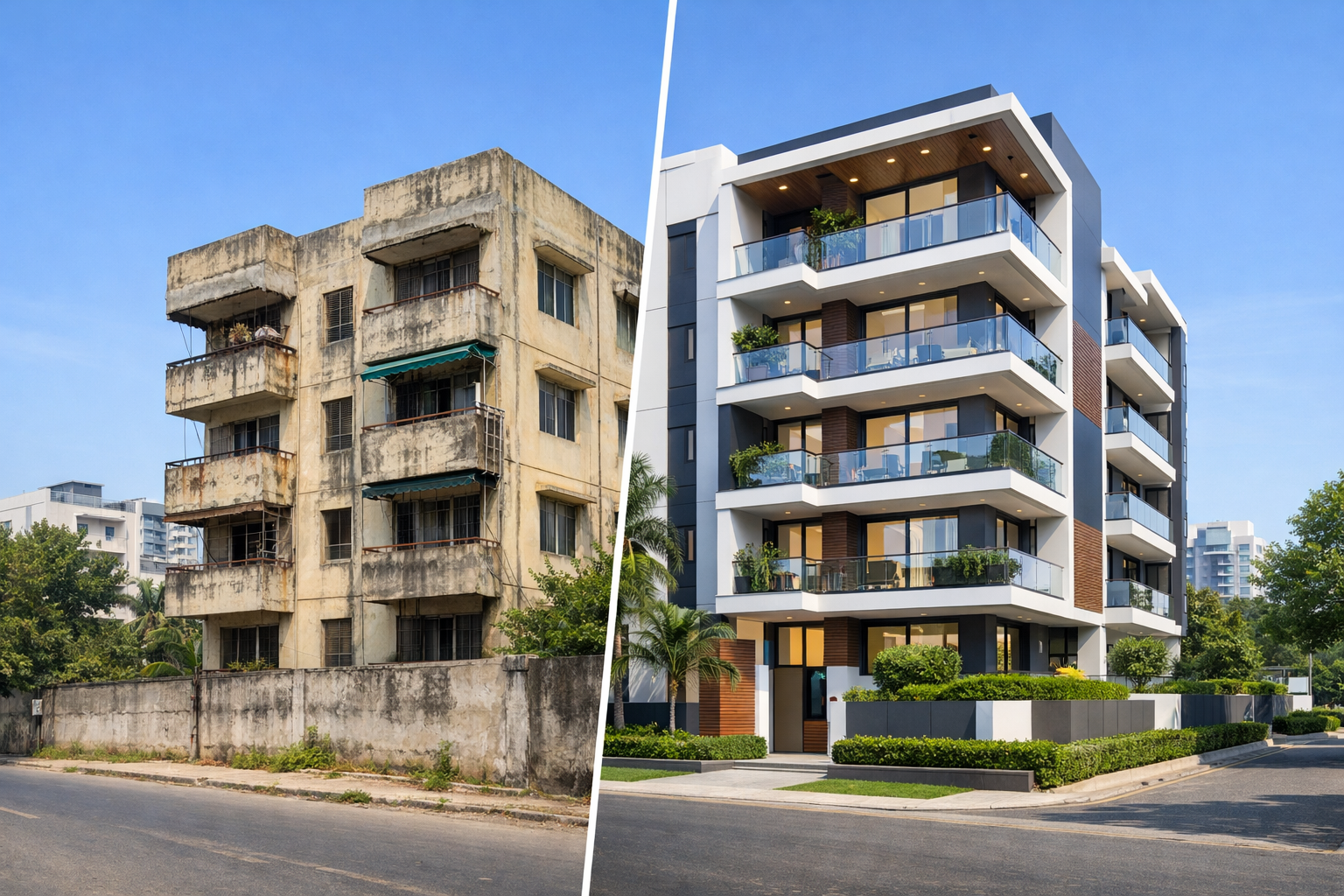
Most Chennai flat owners who begin exploring redevelopment quickly hit the same wall — nobody gives them a straight answer about the CMDA approval process. Developers mention it briefly. Architects say it depends. And housing societies end up moving forward with incomplete understanding of what is legally required, how long it takes, and what can go wrong.
CMDA approval apartment redevelopment Chennai is not optional, and it is not a formality. It is the regulatory foundation on which every legitimate reconstruction project is built. Getting it right — with the correct documents, compliant plans, and a clear submission process — determines whether your project moves forward on schedule or stalls for months waiting for revision responses.
Quick Answer
CMDA approval for apartment redevelopment in Chennai involves submitting architectural plans, structural audit reports, ownership documents, and FSI compliance drawings to the Chennai Metropolitan Development Authority. Approval timelines typically range from three to six months depending on documentation completeness and plan compliance. Incomplete submissions are the primary cause of delays.
What CMDA Approval Actually Covers
The Chennai Metropolitan Development Authority governs all building construction and reconstruction within its jurisdiction. For apartment redevelopment, CMDA building plan sanction confirms that the proposed new structure complies with current zoning rules, FSI norms Chennai permits for the specific plot, setback requirements, building height restrictions, and structural safety standards.
Without this sanction, demolition and construction cannot proceed legally. Any work carried out without valid CMDA clearance for reconstruction exposes flat owners and developers to stop-work orders, penalties, and complications at the occupancy certificate stage.
Step-by-Step: The CMDA Approval Process for Redevelopment
Step 1: Structural Audit and Building Stability Report
Before any plan is drawn, a licensed structural engineer must assess the existing building. The resulting building stability certificate or technical report establishes the condition of the structure and confirms that full reconstruction is warranted. This document is mandatory for the CMDA submission. [Internal Link: Structural Audit Services Chennai]
Step 2: Appointment of a Licensed Architect
CMDA plan submissions must be prepared and signed by a registered architect. The architect translates the redevelopment brief — unit count, floor area, height, parking — into drawings that conform to current CMDA regulations. This includes FSI calculations, setback compliance, and elevation drawings.
Step 3: Document Assembly
The core document set for a CMDA approval apartment redevelopment Chennai submission typically includes the structural audit report, title deed and ownership documents for the plot, registered society resolution with owner consent records, site plan and floor drawings prepared by the licensed architect, FSI calculation sheet, and in some cases, a no-objection certificate from adjacent property owners depending on plot configuration.
Gaps in any of these documents result in a returned submission. Ownership documentation in older Chennai apartment clusters is frequently incomplete due to inheritance transfers, unregistered sales, or outdated records — and this must be resolved before submission, not after. [Internal Link: Redevelopment Process for Flat Owners Chennai]
Step 4: Plan Submission to CMDA
The complete document set is submitted through the CMDA’s online portal or in person at the relevant district office. Upon submission, an acknowledgement and file number are issued. The authority then reviews the plans against current redevelopment regulations.
Step 5: Response, Revision, and Sanction
CMDA may approve the plans, request revisions, or raise specific objections. Most first-time submissions require at least one revision cycle — either for FSI recalculation, setback adjustments, or documentation corrections. Once all objections are resolved and the revised submission is accepted, the building plan sanction is issued.
Step 6: Demolition Permission Chennai
Following plan sanction, a separate application for demolition permission Chennai must be filed. This includes the structural audit report, a demolition safety methodology, and confirmation that residents have vacated or have a confirmed relocation plan. Demolition cannot begin until this permission is granted.
Common Mistakes That Delay CMDA Approval
Submitting plans before ownership documentation is fully cleared. CMDA will not process incomplete ownership records.
Using FSI figures that do not account for road width restrictions or zone-specific limits. Gross FSI and net permissible FSI are not the same number.
Treating CMDA approval as a parallel activity rather than a sequential one. Plan submission must follow the structural audit — not run alongside it.
The Sankar Infra Projects Approach
Sankar Infra Projects manages the full CMDA approval apartment redevelopment Chennai process on behalf of housing societies — from structural audit coordination through plan sanction and demolition permission Chennai filing.
The process begins with a documentation review before any plan is prepared. Ownership records, society resolutions, and FSI calculations are verified independently so that the submission is complete on the first attempt wherever possible. Revision cycles are minimised through preparation, not luck.
The in-house technical team works alongside registered architects to ensure plans comply with current CMDA building plan sanction requirements — covering setback norms, height restrictions, parking provisions, and FSI compliance in a single coordinated submission.
Residents are kept informed throughout the approval process with written status updates. Sankar Infra Projects does not guarantee approval timelines, as these depend on CMDA review schedules and site-specific factors. What they deliver is a submission that is technically sound, fully documented, and professionally managed. [Internal Link: Apartment Reconstruction Services Chennai]
FAQ
How do I get CMDA approval for apartment redevelopment in Chennai? Engage a licensed architect, complete a structural audit, compile ownership and consent documents, and submit compliant plans to CMDA. The process involves multiple stages and typically takes three to six months from a complete submission to plan sanction.
How long does CMDA approval take for a redevelopment project in Chennai? Three to six months is a realistic range for projects with complete documentation and compliant plans. Submissions that require revision cycles extend this timeline. There is no mechanism to fast-track CMDA review.
What documents are required for CMDA sanction for apartment reconstruction? Core documents include the structural audit report, title deed, registered society resolution with owner consent, architect-prepared plans with FSI calculations, site plan, and in some cases a no-objection certificate from adjacent owners. Requirements may vary by locality and plot configuration.
Can CMDA approval be obtained before full resident consent is in place? No. The society resolution with documented owner consent is a mandatory part of the submission. CMDA will not process applications without confirmed ownership and consent records.
Conclusion
CMDA approval apartment redevelopment Chennai is the step that separates a legally protected project from one built on uncertain ground. Understanding the process — the documents required, the sequence of steps, and the common mistakes that cause delays — puts housing societies in a significantly stronger position before any developer agreement is signed.
Approval is not guaranteed, and timelines depend on documentation quality and regulatory review. But preparation makes a measurable difference. Sankar Infra Projects offers free consultations for housing societies that want to understand their CMDA approval process clearly before committing to a redevelopment path. Speak to the team and start with the process, not the promises.
